
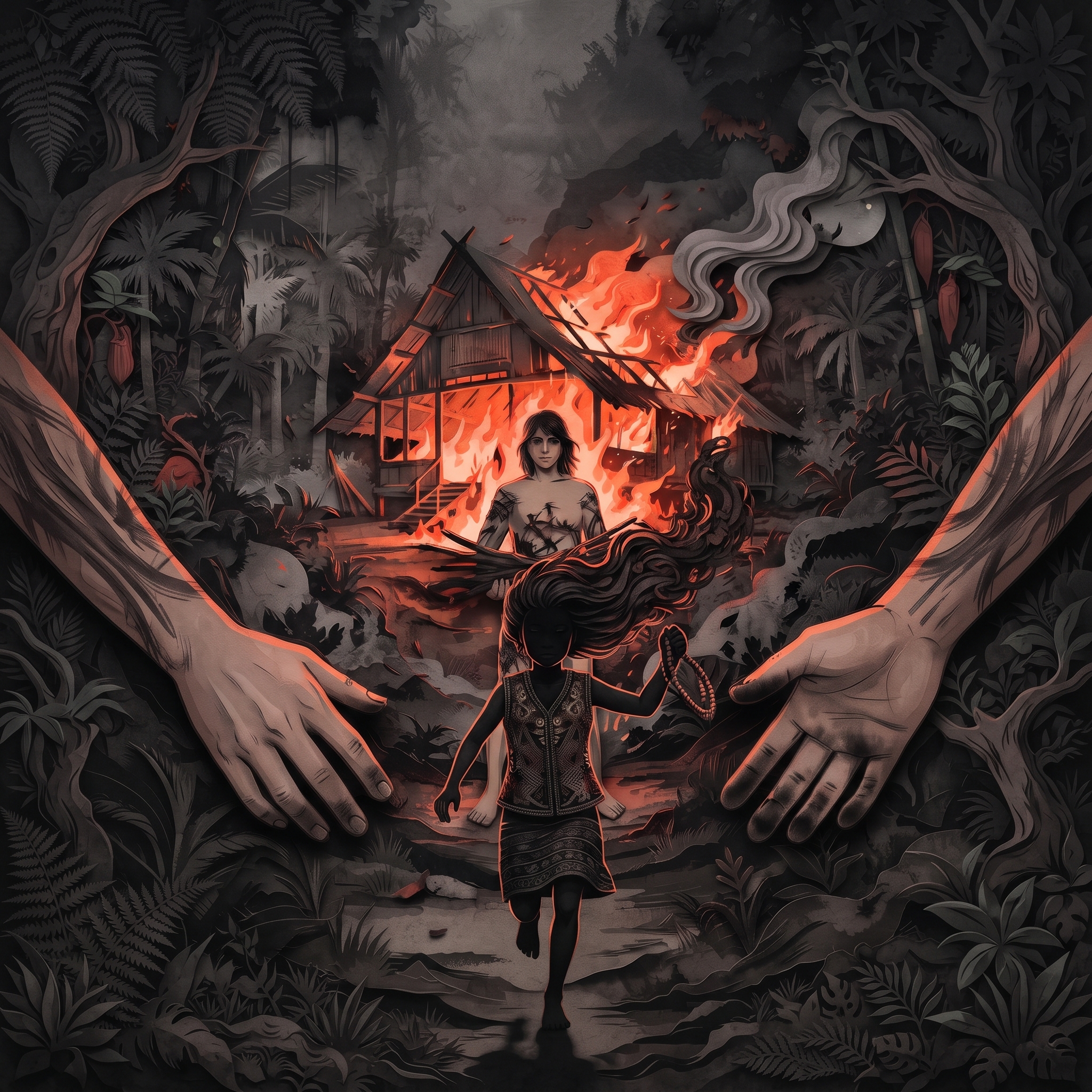
This lyric trilogy is a work of imagination rooted in the emotional and material textures of Borneo longhouse life, not a historical chronicle of any specific people. The “third path” is offered as a quiet counter to the older binaries of pure victory or pure ruin: the difficult, unfinished work of staying.
Introduction
Ash and Charcoal is structured as three interlocking lyric trilogies.
I. The Crimson Longhouse follows Anya, a girl who crawls from the burning of her home at the age of twelve, carrying only her mother’s beads. It traces her transformation into a leader who forges law from ash, and the cost of that forging on those who follow her—and on herself.
II. The Charcoal Longhouse turns to Lutan, the young man who did not light the first torch but kept the fires burning. It examines the quieter violence of usefulness, the black dust that settles into the self, and the slow, incomplete attempt to stop feeding what one has become.
III. Ash and Charcoal brings the two sequences together. It does not offer redemption in the conventional sense. It offers something more difficult: the third path that the old prophecies never named—neither pure destruction nor forced unification, but the unfinished, ordinary work of two scarred people choosing to keep the fire small and the door open.
The poems move between voices—human, non-human, communal—because trauma and survival are never singular. A longhouse is many lives under one roof. So is this book.
Readers will find recurring images: the wounded moon, the clicking beads, the resin sticks, the charcoal pits, the river that carries smoke from one bank to the other and, later, carries quieter things. These are not decorations. They are the grammar through which the characters learn to speak after the old languages of raid and revenge have failed them.
This is not a historical novel in verse. It is a lyric meditation on what we inherit, what we burn, and what we decide—day after ordinary day—to keep.
The rest is residue.
Reading order:
Glossary:
- Mandau: Traditional Dayak sword, both weapon and cultural symbol.
- Sago: Starch extracted from the sago palm; a staple food.
- Ironwood: Dense, durable tropical hardwood used for longhouse pillars.
- Longhouse: Communal dwelling raised on stilts, housing an entire extended community.
- Beads: Heirloom strands, often of stone or glass, carrying lineage, memory, and identity.
- Batang Betuah: The river and surrounding territory associated with Lutan’s people.
- Hiam Daya: The valley and community associated with Anya.
- Nipa / Rattan: Palm thatch and vine used in roof and gallery construction.
Join readers who wait for the next chapter: