
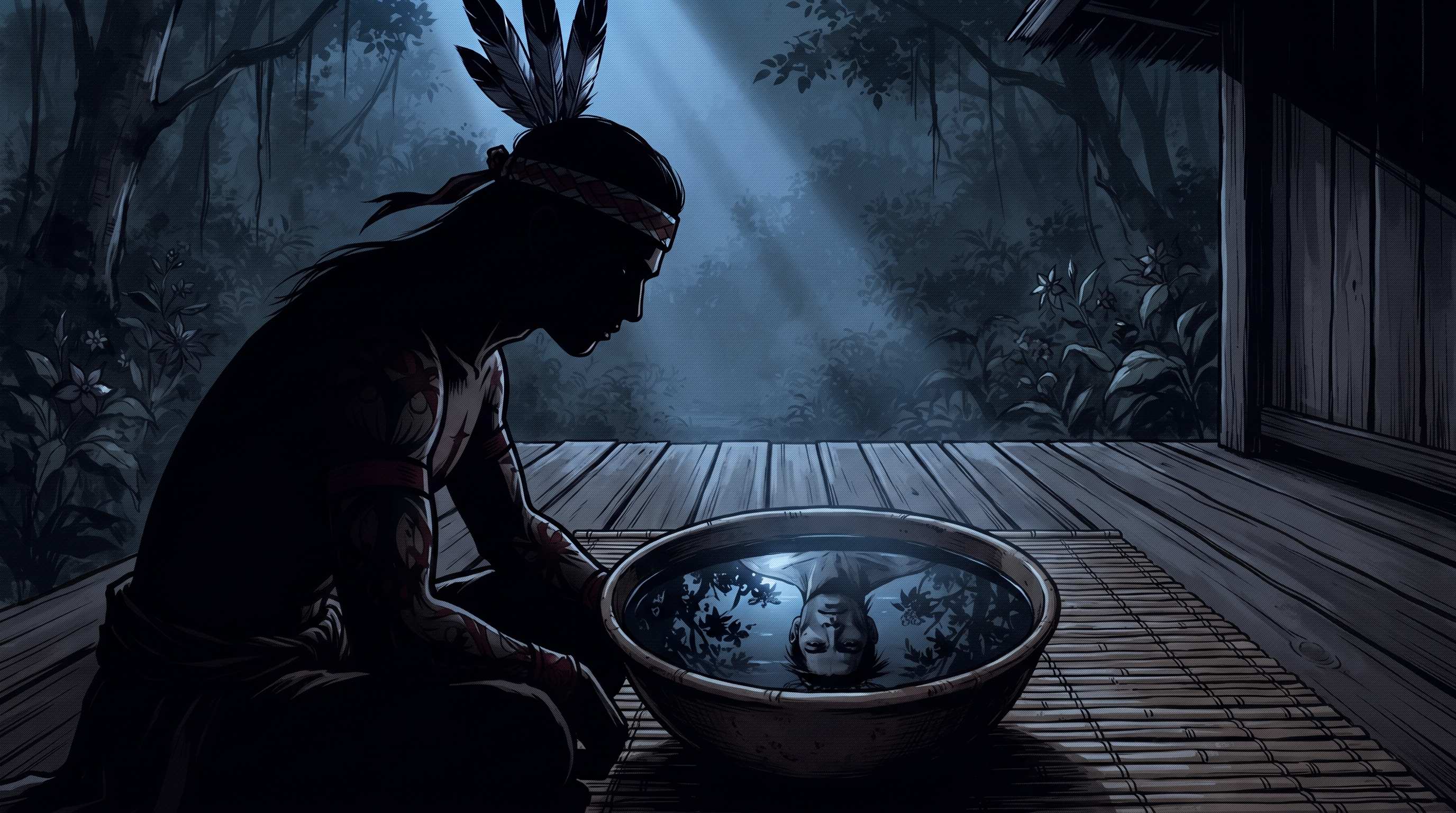
Never hang a mirror in the deep jungle; the night-shade that catches your eye will keep your face forever.
The phantom hunger from the left-handed grain had faded by first light, leaving only a faint memory behind Bungsu’s ribs. The salt lines were renewed, the bamboo tubes washed, and the red threads checked once more. Rain had fallen in the early hours—soft, steady, the kind that left the air clean and the porch boards dark with water.
Sulung stood at the open doorway, looking out at the small wooden bowl that collected rain from the eaves. It sat on the porch rail, still and clear. No one had placed a mirror anywhere in the stilt-house. There had never been one.
“Do not look too long,” Sulung said when he saw Bungsu drifting toward the bowl. “Even rainwater can become a gate if the light is wrong.”
Bungsu stopped a few steps away. “It is only water. How can water keep a face?”
Sulung joined him at the rail but kept his own eyes on the trees beyond. “In the deep jungle a mirror is a door that opens both ways. The night-shade—the thing that walks when the cicadas stop—can reach through glass or still water and take what it sees. It does not steal the whole person at once. It keeps the face. After that, when you look at your own reflection, something else looks back. Mother forbade mirrors the day we moved under these rafters. We use the river only when it is moving, and never a bowl left still after dark.”
Bungsu glanced at the rainwater. The surface held the green of the canopy and a thin strip of pale sky. His own shape appeared there, ordinary at first—dark hair, the red thread visible at his wrist. He leaned a little closer.
For a single heartbeat the face in the water was not his.
The eyes were the same shape, the mouth the same, but the expression belonged to someone older and colder, as if the water had borrowed a different set of thoughts. The skin looked thinner. The gaze did not blink when Bungsu blinked. Then the image shivered, and his own familiar face returned.
He stepped back so quickly the porch boards creaked.
Sulung’s hand closed on his shoulder. “You saw it.”
Bungsu nodded, throat tight. “Only for a moment. It looked like me, but wrong.”
“That is how it begins.” Sulung’s voice stayed low and even, the way it did when he repeated a rule that had already cost someone. “The night-shade tests the surface. If you stare, it learns the map of your face. Later it can wear that map. Or it can keep a piece of it, so that every still pool becomes a place where you are no longer alone.” He tipped the wooden bowl carefully, letting the rainwater spill onto the ground in a broken stream. The reflection vanished with the water. “Moving water forgets. Still water remembers.”
They stood without speaking while the last drops fell from the eaves. The red thread on Bungsu’s wrist felt suddenly important, a small warm fact against the cool morning air. He rubbed the place where the wrong eyes had seemed to watch him.
“Will it come back?” he asked.
“It may try again in any quiet surface—dew on a leaf, a puddle after rain, even the dark shine of polished ironwood if the light catches it strangely. That is why we keep no mirrors and why we empty every bowl before night.” Sulung turned back toward the doorway. “The rule is simple. The cost of breaking it is not.”
Inside, the house felt the same as always—salt lines clean, roof beams quiet, the faint smell of yesterday’s rice still in the air. Yet Bungsu found himself avoiding the water jar and the smooth surface of the cooking pot. When he passed the open window he looked only at the moving leaves, never at the glass-like sheen of wet boards below.
The vision stayed with him through the day: the same face, but older, emptier, watching from a place that should have held only water. He did not speak of it again. Sulung did not ask. The warning had been given, the bowl emptied, the boundary restored.
As evening approached they closed the shutters in the usual order. Salt was scattered once more. The red threads were touched for luck. Outside, the rain had stopped and the forest settled into its night voice. Inside, no mirror hung, and every surface that might hold a still reflection had been turned or drained.
Bungsu lay on his mat and kept his eyes on the dark rafters rather than the faint gleam of the water jar across the room. The wrong face did not return. Still, the knowledge of it remained—an early crack in the ordinary world, small enough to ignore for now, clear enough to remember later. The house held. The night-shade, if it watched, found no open gate.
Grateful you spent time under these rafters with me. 👋
Like, share, or simply say hello in the comments. It means more than you know. ❤️
alam Art artwork Awareness books borneo Culture Dayak digital art Drawing eduART english Experience fantasy fiction FictionStories Idea insect inspired Kabupaten kapuas Hulu Kapuas Hulu Kecamatan Seberuang Learning life musik dayak natural Nature nft nftart nftartwork nftcommunity nftsale putussibau ravencoin rvn rvnft Seberuang Sejiham Sejiram short story Situs Gereja Katolik Santo Fidelis Sejiram story weekend west kalimantan writing
Comments
2 responses to “The Whispering Rafters – 5 – The Mirrorless Homestead”
[…] Previous Next […]
[…] Previous Next […]